
JioAbroad Blog
SEO, YouTube, and LinkedIn for Relocation Research
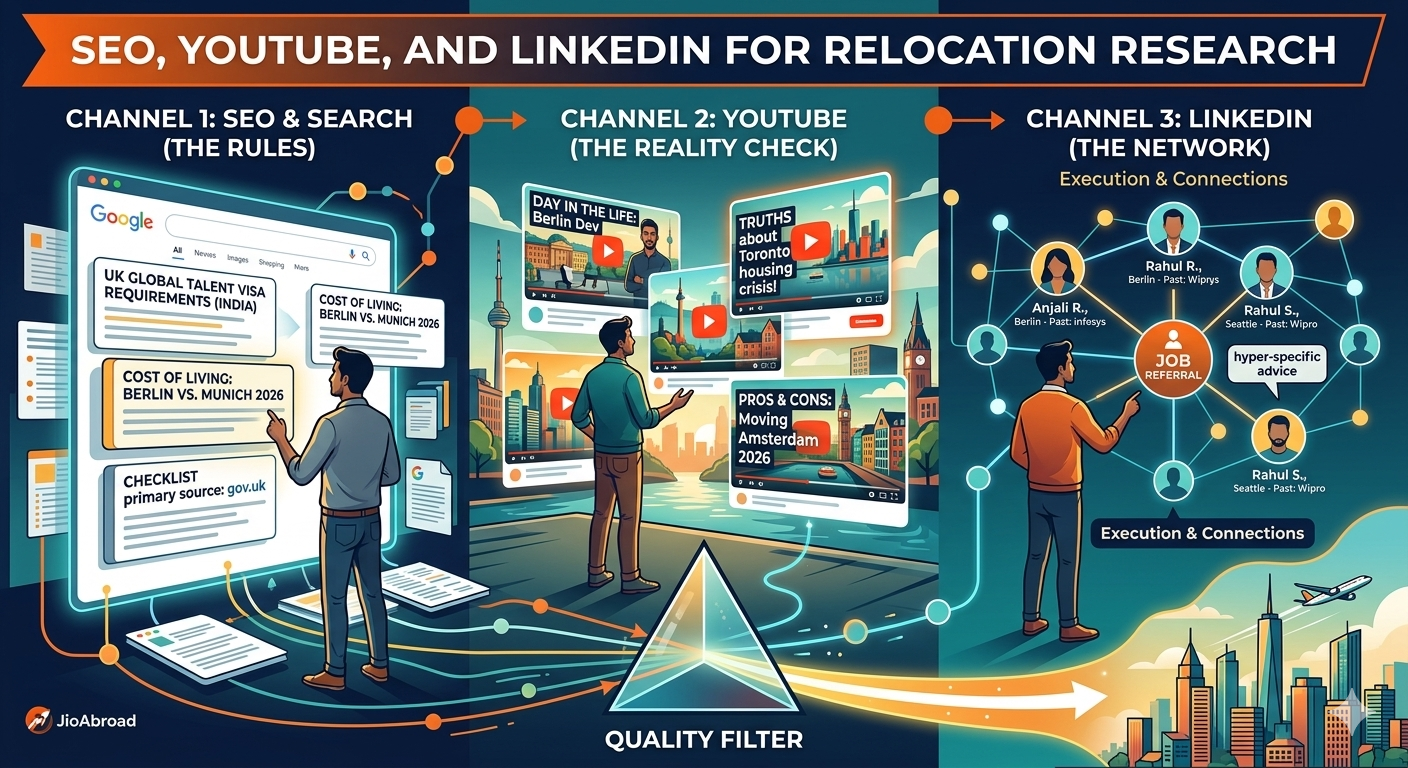
The modern relocation journey does not start in an embassy. It starts in a search bar. For Indian tech professionals planning to move abroad, the first barrier is rarely information scarcity. It is information overload. Between SEO-heavy blogs, polished creator content, and crowded professional feeds, the hardest question becomes: what should you trust?
The successful researcher does not consume every opinion. They move through channels with intent: Search for rules, YouTube for lived reality, LinkedIn for execution pathways. Then they apply a quality filter before making decisions.
Channel 1: SEO and Search (Rule Gathering Phase)
Search is where most journeys begin. You type queries about visa categories, salary thresholds, or city-level costs and expect objective clarity. At its best, Search gives you rule boundaries and official requirements.
At its worst, it gives you lead-generation content disguised as guidance.
How high-intent users actually use Search
They look for baseline constraints first: eligibility criteria, official process stages, legal requirements, and hard deadlines. This creates the outer frame for every later decision.
The trap
Ranking does not guarantee reliability. Many top pages are optimized for clicks, not legal accuracy or timeline nuance. Some are updated slowly. Others oversimplify edge cases that matter in real migrations.
Quality filter for Search content
Check recency: visa and policy shifts can make old advice risky.
Check source linkage: trustworthy guides cite primary government portals.
Check author intent: domain expertise beats generic content farms every time.
Channel 2: YouTube (Reality Check Phase)
Once you understand rules, you need texture: daily life, hidden friction, and practical adaptation. This is why high-intent researchers move to YouTube next.
Video gives context no checklist can provide: commute patterns, rental realities, grocery costs, social integration, weather adaptation, and first-month stress patterns.
How high-intent users actually use YouTube
They use it to test assumptions: “What does this city feel like?” and “What is not visible in official process documents?” It is less about formal policy and more about operational reality.
The trap
Creator content often carries survivorship bias. You usually see people who successfully relocated and stayed. You rarely see failed attempts, unsustainable transitions, or long adjustment struggles. Sponsored narratives can also flatten complexity.
Quality filter for YouTube content
Look for honest downsides: credible creators discuss constraints, not just highlights.
Match persona: student advice cannot be blindly reused for senior professionals with families.
Check practical specificity: useful videos include details, not only motivation.
Channel 3: LinkedIn (Execution and Network Phase)
After rules and reality comes execution. This is where LinkedIn becomes decisive. High-intent users use it to find people who made similar transitions under comparable constraints.
How high-intent users actually use LinkedIn
They search for profile paths, not just job titles: previous company context, relocation route, role progression, and timeline. The objective is practical transfer learning: what worked, what failed, and what changed recently.
The trap
Generic outreach gets ignored. Broad questions create low-quality responses. Advice without trajectory alignment can be directionally wrong for your specific route.
Quality filter for LinkedIn advice
Vet trajectory: understand how the person moved, then compare against your own path.
Ask micro-questions: specific, contextual questions produce useful answers.
Prioritize recency: transitions made in the last 12-18 months reflect current market realities.
The Synthesis: From Information to Decision
No single channel contains the full truth. Search defines boundaries. YouTube tests lived assumptions. LinkedIn enables informed execution.
When you run all three through a strict quality filter, you stop being a passive consumer of relocation content. You become the architect of your transition strategy.
Final Takeaway
The goal is not to read more. The goal is to decide better. Use Search for legal structure, YouTube for practical realism, and LinkedIn for targeted action. Then validate every critical decision against source quality, recency, and profile relevance.
That is how high-intent relocation research becomes a strategic advantage instead of a stress spiral.