
JioAbroad Blog
Career Relocation for Tech Professionals
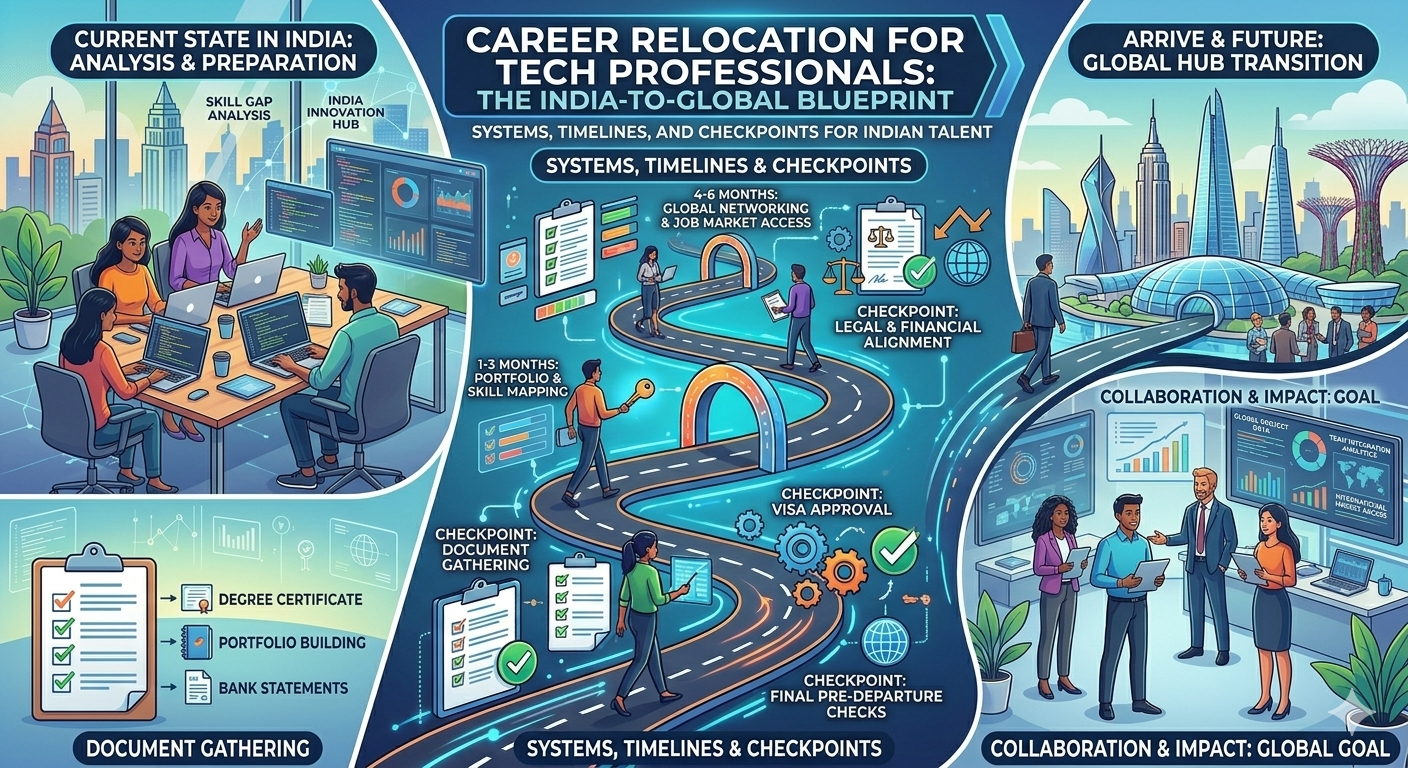
Relocating your technology career from India to a global hub is not a one-time event. It is a multi-year strategic operation that reshapes how you work, what you solve, and who you become. The dream often starts small, perhaps during late-night coding sessions in Bengaluru, product standups in Hyderabad, or architecture reviews in Pune. But the path to global relocation is never linear.
It demands systems thinking. It demands checkpoint discipline. And above all, it demands clarity when everything feels uncertain. The blueprint mindset is simple: move from local analysis to global impact through phased execution.
Phase 1: Analysis and Preparation (Months 1-3)
Every successful relocation starts before applications, before visa forms, and before interviews. It starts with a brutally honest self-audit. In this phase, your objective is to understand not only what you can do, but where your capability is most valuable in global markets.
Portfolio Mapping
Do not describe your career using only job titles. Map your real contribution. What did you build? What performance improved because of your work? What business outcomes moved because of your architecture, model tuning, or product decisions?
Global hiring teams evaluate evidence, not buzzwords. If your strength is cloud architecture, machine learning, platform engineering, or full-stack delivery, quantify it. Numbers travel across borders better than adjectives.
Skill Gap Analysis
The next step is uncomfortable but essential: identify what your target markets require that your current profile does not yet demonstrate. California may require deep product-scale exposure. London may reward regulated-domain experience. Berlin may prioritize engineering quality and cross-functional collaboration.
If certifications, domain proof, or specific project depth are missing, solve it now. Preparation is not a side task; it is the core system that reduces risk later.
Phase 2: The Winding Road of Systems and Checkpoints (Months 4-9+)
Once you understand your value, you enter the active journey. This is where the road becomes complex. The process now includes global networking, selective applications, legal compliance, documentation, and financial realignment, all happening in parallel.
Timeline Milestone: Global Job Search and Networking (Months 4-6)
At this stage, local visibility is not enough. You must design a global discovery system. LinkedIn remains useful, but surface activity is insufficient. Identify relevant engineering managers, recruiters, and product leaders in your target geography. Join focused open-source communities, technical working groups, and domain networks where capability is visible in public.
Then fix your application strategy. Stop mass-applying. High-conversion relocation pipelines are quality-first: role-fit filtering, custom narratives, and evidence of impact aligned to each company context. The goal is not volume. The goal is meaningful interviews.
Critical Checkpoint: Legal, Financial, and Documentary Compliance
This is the most demanding checkpoint for most candidates. One missing document or one late action can delay the entire move. The only way through is operational rigor.
Document Gathering Discipline
Treat documents as a production system. Degrees, reference letters, tax records, employment proof, identity records, and relevant civil certificates should be prepared in a master checklist. Apostille and attestation dependencies must be tracked with deadlines and ownership.
Visa Sequencing and Compliance
Visa paths differ widely: H-1B, L-1, Skilled Worker, and others each carry distinct constraints. Your relocation system should track application windows, timeline variance, and contingency planning for evidence requests. Compliance is not paperwork. Compliance is schedule protection.
Financial Realignment
Relocation creates short-term financial pressure and long-term tax implications. Your preparation should include transition funds, settlement buffers, and cross-border tax planning awareness. A strong career move can be weakened by weak cash-flow planning.
Phase 3: Arrival and Goal Realization in the Global Hub
After the road, the checkpoints, and the waiting, you arrive. Maybe Silicon Valley, maybe London, maybe Singapore or Tokyo. But arrival is not merely geographic. It is professional redefinition.
You move from “aspiring to relocate” to “operating in global systems.” You collaborate with peers solving cross-border product problems, operating at scale, and contributing to international engineering outcomes.
Impact Realization
At this stage, your value is measured through contribution, reliability, and leadership. The global network you entered now becomes an amplifier of your influence.
Legacy and Growth
Career relocation is deeply personal, but its impact is often collective. You become a bridge between ecosystems, and your journey becomes a model for those following similar ambitions.
Final Perspective
The road from India to a global technology career is long, complex, and system-heavy. But with a realistic timeline, checkpoint discipline, and strategic execution, relocation becomes a solvable problem. Master the roadmap. Master the system. Then build your global chapter with intention.